
FDM 3D Printing
FDM (fused deposition modelling) extrudes heated thermoplastic through a nozzle layer by layer.

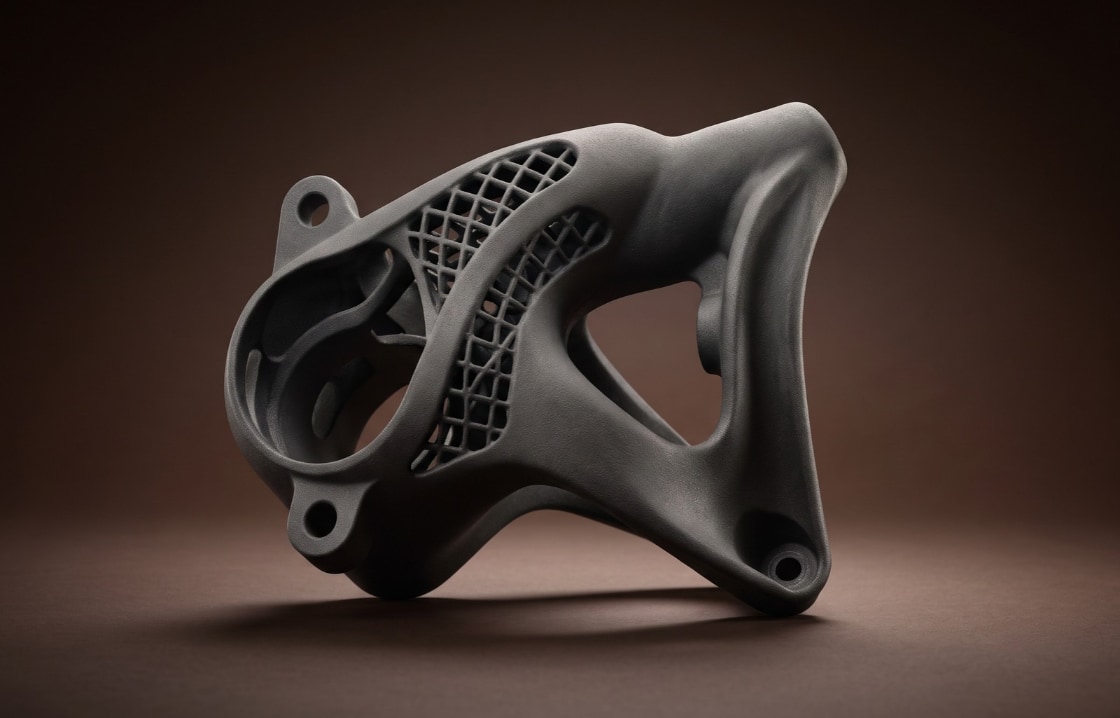
Part of 3D Printing
Multi Jet Fusion 3D printing producing strong, isotropic custom plastic parts for rapid prototyping and low-volume production.
Multi Jet Fusion 3D printing is an industrial powder-bed additive manufacturing technology engineered to produce durable, high-precision polymer components at speed. Powered by HP MultiJet Fusion systems, this process bridges the gap between traditional prototyping and injection molding, enabling engineers and product developers to move seamlessly from prototype to production without investing in expensive tooling.
During the Multi Jet Fusion process, a recoater blade deposits an ultra-thin layer of fine thermoplastic powder across the build bed. High-resolution inkjet arrays then traverse the platform, selectively applying a fusing agent to areas that form the part geometry and a detailing agent along the outer boundaries to sharpen edges and prevent thermal bleed. An overhead infrared energy source passes across the build area, fusing the treated powder into a dense, solid layer. Because the surrounding unfused powder naturally supports the part during printing, complex geometries, internal channels, overhangs, and nested assemblies can be fabricated without dedicated support structures.
Compared to conventional filament-based 3D printing, Multi Jet Fusion delivers near-isotropic mechanical properties, meaning parts exhibit uniform strength and stiffness across the X, Y, and Z axes. High build-bed packing density and planar thermal fusion allow entire batches of 3d printed plastic parts to be produced within days rather than weeks. This combination of speed, repeatability, and material performance makes MJF an ideal rapid prototyping service as well as a reliable solution for low volume manufacturing and bridge production.
Our custom plastic manufacturing workflow supports engineering-grade polymers tailored to demanding industrial environments:
To match functional and aesthetic requirements, custom plastic parts can be finished with media blasting for a uniform matte-grey surface, deep-black dyeing for consistent coloration, or vapor smoothing to seal surface porosity and achieve an injection-molded appearance. Secondary CNC machining and threaded insert installation are also available where critical mechanical interfaces demand tight tolerances.
 Near-Isotropic Mechanical Strength: Consistent tensile strength and stiffness across X, Y, and Z axes for load-bearing end-use parts.High Dimensional Accuracy: Typical tolerances of ±0.3 mm (or ±0.3% for larger dimensions) with minimum feature sizes down to 0.5 mm and wall thicknesses from 0.7 mm.Support-Free Complex Geometries: Unfused powder bed self-supports internal channels, undercuts, lattice structures, and interlocking assemblies without support removal marks.Industrial Polymer Selection: Production in PA12, PA11, and flexible TPU to meet specific mechanical, chemical, and thermal requirements.Scalable Batch Throughput: High-density 3D nesting enables rapid turnaround from single prototypes to repeatable serial production runs of hundreds or thousands of parts.Comprehensive Finishing Options: Bead blasting, deep-black dyeing, vapor smoothing, heat-set threaded inserts, and precision CNC post-machining.
Unlike FDM, which extrudes filament layer by layer and creates visible layer lines and weaker Z-axis bonding, Multi Jet Fusion fuses an entire cross-section at once using infrared lamps and inkjet agents. This results in near-isotropic strength, sharper edge definition via detailing agents, and no support scars. Compared to Selective Laser Sintering (SLS), MJF typically achieves faster build speeds, higher part density, and more consistent surface smoothness across batches.
We produce MJF parts in industrial-grade PA12 (balanced strength and rigidity), PA11 (high impact resistance and ductility), and TPU (flexible elastomer). Parts come standard with a bead-blasted natural grey finish and can be dyed deep black or treated with vapor smoothing to seal surface pores, reduce roughness, and improve resistance to liquids and moisture.
Multi Jet Fusion maintains reliable dimensional tolerances of ±0.3 mm (or ±0.3% for features over 100 mm) and supports fine walls down to 0.7 mm. Because it requires no molds or tooling setup, MJF is economically ideal from a single rapid prototype up to low- and mid-volume production runs of several thousand parts.
FDM (fused deposition modelling) extrudes heated thermoplastic through a nozzle layer by layer.
SLA (stereolithography) cures liquid photopolymer resin with a UV laser, layer by layer.
DLP (digital light processing) cures an entire resin layer at once with a projector.
SLS (selective laser sintering) fuses nylon powder with a laser.